St. Eustache - Paris, France
Eglise Saint-Eustache
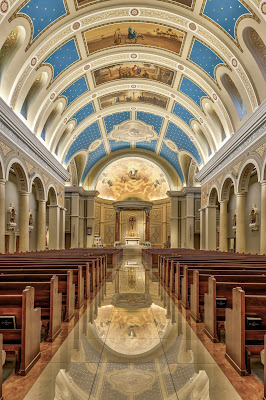
On our first full day in Paris we visited several churches around the city. An internet search during lunch brought up the Church of Saint Eustache. Based on length, Saint Eustache is the third largest church in Paris, coming in at 344 feet. We took the metro and were greeted with this view of the church as we exited the station.

The Church of Saint-Eustache (Église Saint-Eustache) is one of Paris's most impressive and historically rich churches, blending Gothic architecture with Renaissance and classical elements. Located in the Les Halles district, it has long stood as a spiritual and cultural landmark in the heart of Paris.
Origins and Construction (13th–17th centuries)
-
The original parish chapel was built in 1213, dedicated to Saint Agnes.
-
In 1532, construction began on the current church, which was renamed after Saint Eustace, a Roman general who converted to Christianity and was martyred.
-
Though inspired by Gothic cathedrals (like Notre-Dame), Saint-Eustache's design incorporates Renaissance details such as classical columns and rounded arches.
-
The church took more than a century to complete and was consecrated in 1637, though some finishing touches continued into the 18th century.

Architectural Highlights
-
Gothic structure: High vaulted ceilings, flying buttresses, and a grand nave.
-
Renaissance façade: Though the church is mainly Gothic, the western façade was redone in a classical style during the 18th century.
-
Massive dimensions: It's nearly the same size as Notre-Dame, and its organ is one of the largest in France.
-
Stained glass windows, sculptures, and chapels throughout reflect centuries of religious and artistic patronage.
-
Saint-Eustache was closely tied to the Les Halles market and the lives of ordinary Parisians.
-
It hosted many important events:
-
Baptism of Cardinal Richelieu (1585)
-
First Communion of Louis XIV
-
Funeral of Mozart’s mother (1778)
-
-
During the French Revolution, it was desecrated and repurposed, like many churches, before being restored to religious use in the 19th century.
-
It survived the Paris Commune and both World Wars largely intact, though it required restorations.



Comments
Post a Comment